
How this product class behaves
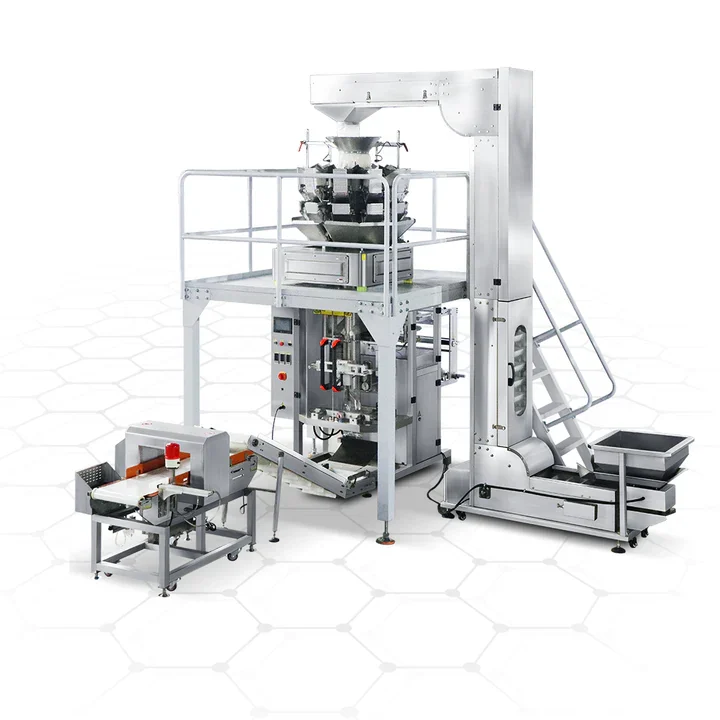
The typical process uses linear weigher, multihead weigher, cup filler or counting system supplied through controlled elevator or vibratory feed that avoids product breakage and surges. The equipment should be configured to match the dosing system to piece size, target weight, fragility and permitted giveaway.
Before discussing speed or automation, define the actual operating window: minimum and maximum dose, product temperature, density, viscosity or bulk density, inclusions, foam, shear sensitivity, corrosivity, pack dimensions and closure. A single nominal sample is not enough for a robust specification.
Recommended filling technologies
Primary route
Linear weigher, multihead weigher, cup filler or counting system.
Product supply
Controlled elevator or vibratory feed that avoids product breakage and surges.
Critical control
Match the dosing system to piece size, target weight, fragility and permitted giveaway.
Temperature and product condition
Normally ambient with moisture control where caking is possible. Temperature changes may alter viscosity, foam, gas breakout, dose accuracy, closure performance or pack stability. Define where temperature is measured and the permitted deviation.
Cleaning, changeover and material compatibility
Plan for removable contact parts and safe access beneath weigh heads and feed trays. Product-contact materials, elastomers, lubricants, surface finish and drainage should be reviewed against every formulation. Include safe access, line clearance, product recovery and waste handling.
Principal production risks
Risk focus
Bridging, breakage, static, poor distribution and product trapped in seals. The process and machinery risk assessments should cover normal running, refill, sampling, adjustment, blockage clearance, cleaning and maintenance.
What to prove in a product trial
- Repeatable dose at minimum and maximum line speed
- Clean cut-off and acceptable pack presentation
- Stable product feed through refilling and batch end
- Changeover and cleaning time using the intended method
- Closure, label, code and distribution performance after filling
Example product applications
Pasta Sauce in Jars and Tubs
Granules and free-flowing solids
Sauces & condimentsPasta Sauce in Stand-up Pouches
Granules and free-flowing solids
Sauces & condimentsPasta Sauce in Portion Sachets
Granules and free-flowing solids
Sauces & condimentsPasta Sauce in Retail Bags
Granules and free-flowing solids
Sauces & condimentsPasta Sauce in Drums and Bulk Containers
Granules and free-flowing solids
Edible oils & vinegarsRice Vinegar in Jars and Tubs
Granules and free-flowing solids
Edible oils & vinegarsRice Vinegar in Stand-up Pouches
Granules and free-flowing solids
Edible oils & vinegarsRice Vinegar in Portion Sachets
Granules and free-flowing solids
Edible oils & vinegarsRice Vinegar in Retail Bags
Granules and free-flowing solids
Edible oils & vinegarsRice Vinegar in Drums and Bulk Containers
Granules and free-flowing solids
Plant-based foods & drinksOat Drink in Jars and Tubs
Granules and free-flowing solids
Plant-based foods & drinksOat Drink in Stand-up Pouches
Granules and free-flowing solids
Common questions
Which filling machine suits a granules and free-flowing solids?
A linear weigher, multihead weigher, cup filler or counting system is the normal starting point. Final selection depends on dose, accuracy, product feed, temperature, pack, cleaning, contact materials and required output.
Why are product samples needed before specifying a filler?
Published viscosity or density values do not show aeration, particles, stringing, shear sensitivity, temperature effects or interaction with the nozzle and pack. A representative test exposes these issues before manufacture.
Can one machine cover several product viscosities or formats?
Often yes, within a defined operating window. The specification should identify the easiest and most difficult products, smallest and largest doses, every pack height and diameter, and the acceptable changeover method.
How is filling accuracy confirmed?
Agree whether the target is volume or mass, the permitted tolerance, test method and sampling frequency. Measure warm-up, hopper refill, speed changes and end-of-batch conditions rather than only stable running.
What determines the real line speed?
The slowest repeatable operation governs output. Product refill, container loading, filling time, closure handling, label application, rejects, accumulation, cleaning and operator intervention all affect the sustainable rate.